Follow the collection
Library Cave (Cave 17), then and now
Start at the original library, follow the surviving objects to their present holders, and open their digitized pages side by side. Every transition stays attached to its source.
01 · Origin
The original library
Mogao Caves UNESCO site; Cave 17 manuscripts dispersed (1907–08) to London, Paris and elsewhere
Enter the library record and any real or reconstructed views
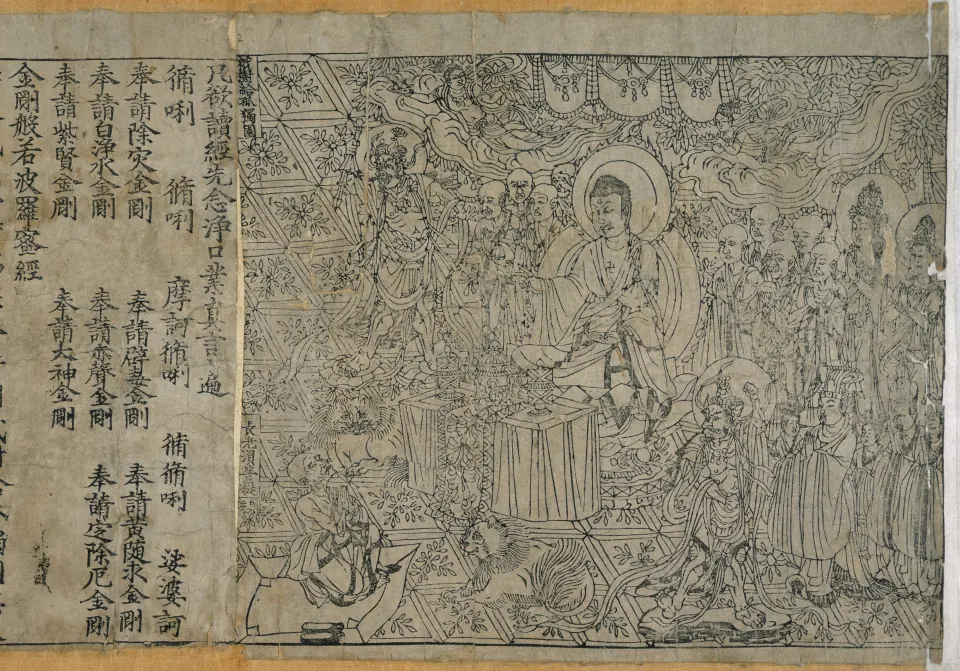
Use this photo
Frontispiece of the Diamond Sutra, printed 868 CE, found in the Library Cave (Cave 17), Mogao; now in the British Library. Photo: The colophon, at the inner end, reads: Reverently [caused to be] made for universal free distribution by Wang Jie on behalf of his two parents on the 13th of the 4th moon of the 9th year of Xiantong [i.e. 11th May, CE 868 ]., Public domain, via Wikimedia Commons: https://commons.wikimedia.org/wiki/File:Jingangjing.jpgDownload 1920px
What happened here
- 1006Cave 17 walled up early 11th century; reason debated (Stein: waste repository; Khotan fell to Karakhanids 1006; fear of 'Age of Decline') · source
- 1900Wang Yuanlu finds the walled-up cave, 25 June 1900 · source
- 1904Wang re-seals cave on governor's order · source
- 1907Dispersed: Stein 1907, Pelliot 1908, Otani 1911, Oldenburg 1914 · source
Where the books are now
Surviving items, by the institution that holds them today. Each line has its source and how well it is proven.
- British Library London, United Kingdom
Stein collection of Dunhuang manuscripts
- Bibliothèque nationale de France Paris, France
Pelliot collection, mostly Chinese and Tibetan texts Count: 7,000
- National Library of China Beijing, China
Manuscripts brought to Beijing in 1910 Count: 16,000
- Institute of Oriental Manuscripts, Russian Academy of Sciences Saint Petersburg, Russia
Oldenburg collection of fragments, plus 365 scrolls Count: 19,000
- Tokyo National Museum Tokyo, Japan
Dunhuang manuscripts in the museum collection
03 · Survival
The present holders
- British LibraryLondon, United Kingdom
Stein collection of Dunhuang manuscripts.
- Bibliothèque nationale de FranceParis, France
Pelliot collection, mostly Chinese and Tibetan texts, 7,000 items.
- National Library of ChinaBeijing, China
Manuscripts brought to Beijing in 1910, 16,000 items.
- Institute of Oriental Manuscripts, Russian Academy of SciencesSaint Petersburg, Russia
Oldenburg collection of fragments, plus 365 scrolls, 19,000 items.
- Tokyo National MuseumTokyo, Japan
Dunhuang manuscripts in the museum collection.
04 · Comparison
One desk, many surviving copies
Choose two holders, then turn their pages together. The desk reads IIIF v2 and v3 manifests cached at build time; images still come from the holding institutions.